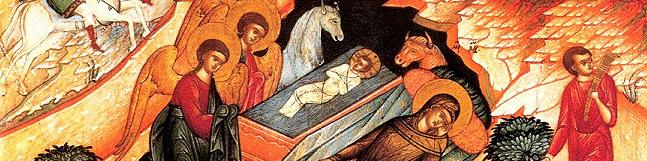
The real insight of Augustine’s psychological analogy for the Trinity is not its “explanation” of the fecund mystery of the divine nature, but rather its discovery that the mind is a created pattern of Trinitarian existence naturally and supernaturally - by divine grace – fit for participation in Uncreated Life.
Showing posts with label Orthodoxy. Show all posts
Showing posts with label Orthodoxy. Show all posts
Friday, September 21, 2007


Monday, July 23, 2007
Ecumenical Dialogue
A Catholic friend of mine had a very good conversation recently about the latest CDF clarification regarding Catholic Theology of the Church and how it relates to the Orthodox.
'What is missing from the particular expression which the Orthodox churches, both individually and collectively, give to the universal Church is that element of the universal Church which I have described as the Petrine ministry. Since the Apostolic Church, gathered on that first Pentecost Sunday, in the fellowship of the body of Christ, with the Theotokos, under the headship of Peter, is the most pure expression of the universal Church, the absence of any one of those elements would constitute an imperfect expression of the universal Church.'
Tuesday, July 17, 2007
Seven Interesting Facts about the History of the Filioque in the West
The fathers of the Second Ecumenical Council of Constantinople (381) did not intend to define the manner of the Spirit’s procession from the Father, but only to affirm, in language acceptable to the various positions which existed at the time, the full divinity of the Spirit.
The Second Ecumenical Council of Constantinople (381) was not regarded universally as an ecumenical council, especially in the West, until it was declared such by the Fourth Ecumenical Council at Chalcedon (451).
During this time (381-451) there were in the West other forms of the creed, such as The Apostles’. At the same time, there was a tradition coming from the Latin fathers, especially Augustine, which taught the doctrine of the filioque.
Due to distance, cultural difference, language, human error, etc. (historians do not know the exact details), in the 6th century a Latin version of the original creed of Constantinople was published in Spain by the local council of Toledo which added the filioque. It appears that this council considered the filioque clause part of the original. This indicates that such confusion might have been common in the West. Also, it was taken to be an anti-Arian clause, which made it natural, though incorrect, to assume that it was part of the original creed of Constantinople. It is about this time, in both the East and the West that the creed began to be said in the celebration of the Eucharist.
By the 8th century the Carolingian Empire was competing with the Byzantine Empire for its claim to be the true heir to the Roman Imperium in the West. In this context, the filioque (as a doctrine as much as a liturgical addition) had a two-fold function. First, it served the interests of Frankish theologians, especially Alcuin, to condemn what appeared to them to be the heresy of adoptionism in some Spanish churches. Second, it was used by Charlemagne, in his political struggle, to question the orthodoxy of the Byzantine court. It is important to note that, at this time, the filioque clause was added to the original creed of Constantinople in the Frankish dominions but not in those of the Roman See.
Despite Papal support for the theology of the filioque – which had a firm foundation in the Latin fathers – and which was expressed in defense of Western monks in Jerusalem who has been accused by Eastern monks in the early 9th century of heresy for their addition of the filioque to the Latin version of the creed of Constantinople, the filioque clause was deliberately not added to the text of the original Greek or its Latin translation by the Popes of Rome. In fact, the creed itself was introduced into the Mass in Rome not until the 11th century. By that time the Western Empire has passed from the Franks to the Germans and the filioque was added to the original creed of Constantinople in Latin in the Roman rite.
There were two major reunion councils in the medieval period attended by representatives of the Eastern Churches. The first was the Second Council of Lyons (1274). This council was hostile to any view of the origin of the Holy Spirit other than that expressed by the filioque. The second was the Council of Ferrara-Florence. It was attended by representatives from the churches of Constantinople, Alexandria, Antioch, and Jerusalem. It recognized the legitimacy of the Western view of the Spirit’s eternal procession and suggested that the filioque was the same in meaning as certain expressions used by the Greek fathers of the Church in which the Spirit is said to proceed “through the Son.” The decrees of neither of these councils were accepted in the East. The latter council marked the end of serious reunion efforts until the 20th century.
The Second Ecumenical Council of Constantinople (381) was not regarded universally as an ecumenical council, especially in the West, until it was declared such by the Fourth Ecumenical Council at Chalcedon (451).
During this time (381-451) there were in the West other forms of the creed, such as The Apostles’. At the same time, there was a tradition coming from the Latin fathers, especially Augustine, which taught the doctrine of the filioque.
Due to distance, cultural difference, language, human error, etc. (historians do not know the exact details), in the 6th century a Latin version of the original creed of Constantinople was published in Spain by the local council of Toledo which added the filioque. It appears that this council considered the filioque clause part of the original. This indicates that such confusion might have been common in the West. Also, it was taken to be an anti-Arian clause, which made it natural, though incorrect, to assume that it was part of the original creed of Constantinople. It is about this time, in both the East and the West that the creed began to be said in the celebration of the Eucharist.
By the 8th century the Carolingian Empire was competing with the Byzantine Empire for its claim to be the true heir to the Roman Imperium in the West. In this context, the filioque (as a doctrine as much as a liturgical addition) had a two-fold function. First, it served the interests of Frankish theologians, especially Alcuin, to condemn what appeared to them to be the heresy of adoptionism in some Spanish churches. Second, it was used by Charlemagne, in his political struggle, to question the orthodoxy of the Byzantine court. It is important to note that, at this time, the filioque clause was added to the original creed of Constantinople in the Frankish dominions but not in those of the Roman See.
Despite Papal support for the theology of the filioque – which had a firm foundation in the Latin fathers – and which was expressed in defense of Western monks in Jerusalem who has been accused by Eastern monks in the early 9th century of heresy for their addition of the filioque to the Latin version of the creed of Constantinople, the filioque clause was deliberately not added to the text of the original Greek or its Latin translation by the Popes of Rome. In fact, the creed itself was introduced into the Mass in Rome not until the 11th century. By that time the Western Empire has passed from the Franks to the Germans and the filioque was added to the original creed of Constantinople in Latin in the Roman rite.
There were two major reunion councils in the medieval period attended by representatives of the Eastern Churches. The first was the Second Council of Lyons (1274). This council was hostile to any view of the origin of the Holy Spirit other than that expressed by the filioque. The second was the Council of Ferrara-Florence. It was attended by representatives from the churches of Constantinople, Alexandria, Antioch, and Jerusalem. It recognized the legitimacy of the Western view of the Spirit’s eternal procession and suggested that the filioque was the same in meaning as certain expressions used by the Greek fathers of the Church in which the Spirit is said to proceed “through the Son.” The decrees of neither of these councils were accepted in the East. The latter council marked the end of serious reunion efforts until the 20th century.
Tuesday, May 22, 2007
St. Philaret On Tradition and Divine Attributes
The following questions are taken from the authorized English translation of the Catechism of St. Philaret, Metropolitan of Moscow, 1821 to 1867, whose official title is A Full Catechism of the Orthodox Catholic Church of the East, examined and approved by the Most Holy Governing Synod, and published for the Use of Schools and of all Orthodox Christians, by order of His Imperial Majesty (1839). According to Schaff, the Catechism was unanimously approved by all the Eastern Patriarchs.
The following questions (17 & 18) give a good definition of what is meant by the word ‘Tradition’ with respect to its mode of transmission and content. Note my comments in brackets.
17. What is meant by the name holy tradition?
By the name holy tradition is meant the doctrine of the faith, the law of God, the sacraments, and the ritual as handed down by the true believers and worshipers of God [note that it does not say Bishops or Magisterium] by word and example from one to another, and from generation to generation.
18. Is there any sure repository of holy tradition?
All true believers united by the holy tradition of the faith [as defined above], collectively and successively, by the will of God, compose the Church; and she is the sure repository of holy tradition, or, as St. Paul expresses it, The Church of the living God, the pillar and ground of the truth.
The following question (21) is a good synopsis of the need to recognize the historical primacy of Tradition.
21. Which is the more ancient, holy tradition or holy Scripture?
The most ancient and original instrument for spreading divine revelation is holy tradition. From Adam to Moses there were no sacred books. Our Lord Jesus Christ himself delivered his divine doctrine and ordinances to his Disciples by word and example, but not by writing. The same method was followed by the Apostles also at first, when they spread abroad the faith and established the Church of Christ. The necessity of tradition is further evident from this, that books can be available only to a small part of mankind, but tradition to all.
The following question (22) addresses the purpose of sacred Scripture in light of the comprehensive nature of Tradition. The answer given does not seem to reflect the per se sovereignty and solidity of Tradition sometimes insisted on by enthusiastic Orthodox. It also seems to imply a priority to Scripture in the determination of Apostolic teaching.
22. Why, then, was holy Scripture given?
To this end, that divine revelation might be preserved more exactly and unchangeably. In holy Scripture we read the words of the Prophets and Apostles precisely as if we were living with them and listening to them, although the latest of the sacred books were written a thousand and some hundred years before our time.
The following questions (84 & 86), taken from the First Part of the Catechism, on Faith, do not appear to reflect the Palamite distinction between essence and energies in so far as it speaks of the “essential attributes of God” and even lists among them some conspicuous examples of the former.
84. Can we know the very essence of God?
No. It is above all knowledge, not of men only, but of angels.
86. What idea of the essence and essential attributes of God may be derived from divine revelation?
That God is a Spirit, eternal, all-good, omniscient, all-just, almighty, omnipresent, unchangeable, all-sufficing to himself, all-blessed.
The following questions (17 & 18) give a good definition of what is meant by the word ‘Tradition’ with respect to its mode of transmission and content. Note my comments in brackets.
17. What is meant by the name holy tradition?
By the name holy tradition is meant the doctrine of the faith, the law of God, the sacraments, and the ritual as handed down by the true believers and worshipers of God [note that it does not say Bishops or Magisterium] by word and example from one to another, and from generation to generation.
18. Is there any sure repository of holy tradition?
All true believers united by the holy tradition of the faith [as defined above], collectively and successively, by the will of God, compose the Church; and she is the sure repository of holy tradition, or, as St. Paul expresses it, The Church of the living God, the pillar and ground of the truth.
The following question (21) is a good synopsis of the need to recognize the historical primacy of Tradition.
21. Which is the more ancient, holy tradition or holy Scripture?
The most ancient and original instrument for spreading divine revelation is holy tradition. From Adam to Moses there were no sacred books. Our Lord Jesus Christ himself delivered his divine doctrine and ordinances to his Disciples by word and example, but not by writing. The same method was followed by the Apostles also at first, when they spread abroad the faith and established the Church of Christ. The necessity of tradition is further evident from this, that books can be available only to a small part of mankind, but tradition to all.
The following question (22) addresses the purpose of sacred Scripture in light of the comprehensive nature of Tradition. The answer given does not seem to reflect the per se sovereignty and solidity of Tradition sometimes insisted on by enthusiastic Orthodox. It also seems to imply a priority to Scripture in the determination of Apostolic teaching.
22. Why, then, was holy Scripture given?
To this end, that divine revelation might be preserved more exactly and unchangeably. In holy Scripture we read the words of the Prophets and Apostles precisely as if we were living with them and listening to them, although the latest of the sacred books were written a thousand and some hundred years before our time.
The following questions (84 & 86), taken from the First Part of the Catechism, on Faith, do not appear to reflect the Palamite distinction between essence and energies in so far as it speaks of the “essential attributes of God” and even lists among them some conspicuous examples of the former.
84. Can we know the very essence of God?
No. It is above all knowledge, not of men only, but of angels.
86. What idea of the essence and essential attributes of God may be derived from divine revelation?
That God is a Spirit, eternal, all-good, omniscient, all-just, almighty, omnipresent, unchangeable, all-sufficing to himself, all-blessed.
Monday, May 07, 2007
Scripture and Tradition
The idea of Sacred Tradition has undergone a great deal of development over the centuries. The material distinction between Scriptural Doctrine and the Doctrines of Tradition was not made a formal part of theological study until the 14th c. at the earliest (it most notably appeared among the counciliarist theologians associated with the Council of Constance and its condemnation of Wycliffe’s doctrines, among which was a primitive form of sola scriptura). And even then there were those who objected to the idea that a doctrine (de fide) can be established without any appeal to the literal sense of the Sacred Text. Aquinas (who saw this issue very differently than some of his later hyper-Papal brother Dominicans) had already asserted the necessity of Scriptural support for doctrine:
"Nevertheless...nothing necessary to faith is contained under the spiritual sense [of the biblical text] which is not elsewhere put forward by the Scripture in its literal sense." STh, I., q. 1, ad. 3
The Ecumenical Council of Trent (as has been noted by several scholars including Yves Congar and Joseph Ratzinger) did not decide the question of whether Sacred Tradition is a secondary source of doctrine in the sense that it supplies doctrines not found either explicitly or implicitly in Sacred Scripture or whether it only exhibits (albeit in a different and equally authoritative way) the same doctrine substantially contained within the Apostolic Writings. The Second Vatican Ecumenical Council may have in fact decided in favor of the older (second) view. When it says, "Sacred Tradition and sacred Scripture, then, are bound closely together, and communicate one with the other (DV, 9)", it seems to be saying that they contain the same doctrine, i.e., communicate, 'share' in the same substance, which is the Doctrine of the Gospel. Granted, it leaves the Theology of Revelation with respect to this issue still undeveloped and ambiguous when it says that "[they] come together in some fashion to form one thing, and move towards the same goal (ibid.)", but then it also says, "Sacred Tradition and sacred Scripture make up a single sacred deposit of the Word of God, which is entrusted to the Church." The word "single" in the previous sentence seems to corroborate the interpretation already given to the meaning of the word "communicate". Either way, it is false to claim that there is a definite teaching of the Church on this matter.
The Orthodox Church, on the other hand, seems to have a much less definite view of the relationship between Scripture and Tradition, giving priority to Holy Tradition. The Reformation doctrine of sola scriptura has its roots in the primacy of Scripture characteristic of the Western Roman Catholic theological tradition.
"Nevertheless...nothing necessary to faith is contained under the spiritual sense [of the biblical text] which is not elsewhere put forward by the Scripture in its literal sense." STh, I., q. 1, ad. 3
The Ecumenical Council of Trent (as has been noted by several scholars including Yves Congar and Joseph Ratzinger) did not decide the question of whether Sacred Tradition is a secondary source of doctrine in the sense that it supplies doctrines not found either explicitly or implicitly in Sacred Scripture or whether it only exhibits (albeit in a different and equally authoritative way) the same doctrine substantially contained within the Apostolic Writings. The Second Vatican Ecumenical Council may have in fact decided in favor of the older (second) view. When it says, "Sacred Tradition and sacred Scripture, then, are bound closely together, and communicate one with the other (DV, 9)", it seems to be saying that they contain the same doctrine, i.e., communicate, 'share' in the same substance, which is the Doctrine of the Gospel. Granted, it leaves the Theology of Revelation with respect to this issue still undeveloped and ambiguous when it says that "[they] come together in some fashion to form one thing, and move towards the same goal (ibid.)", but then it also says, "Sacred Tradition and sacred Scripture make up a single sacred deposit of the Word of God, which is entrusted to the Church." The word "single" in the previous sentence seems to corroborate the interpretation already given to the meaning of the word "communicate". Either way, it is false to claim that there is a definite teaching of the Church on this matter.
The Orthodox Church, on the other hand, seems to have a much less definite view of the relationship between Scripture and Tradition, giving priority to Holy Tradition. The Reformation doctrine of sola scriptura has its roots in the primacy of Scripture characteristic of the Western Roman Catholic theological tradition.
Reflections on Orthodox Catholic Differences
Some thoughts I had yesterday at Mass regarding the differences between the Western Catholic and Eastern Orthodox Churches.
The spirituality of the Western Church – borrowing a metaphor from sacramental and liturgical theology – could be described as an imminent (this-worldly) Eucharist; whereas the Eastern would then have to be described as a transcendent (other-worldly) Eucharist. By this I am not saying that either Church essentially lacks imminence or transcendence, but rather that in each Church, respectively, one or the other is a dominant element. Obviously, both Churches seek a balance; the particular character of that synthesis is, however, different. Similarly, the doctrine of the Incarnation is the distinguishing principle in the Western Church; whereas the doctrine of Deification is the distinguishing principle in the Eastern Church. Again, both Churches embrace these doctrines in their essential relatedness; however, with differing emphasis and priority.
No one can dispute the transportative character of the Divine Liturgy. This is not a feature of the Holy Mass (even before the change of the Liturgy). The very materials used to express the spiritual qualities of worship between these two Churches exhibit the aforementioned attitude (ex., icons vs. freestanding statues).
The reason for this is primarily historical. At the zenith of Byzantine Christianity in the early Middle Ages the Eastern Roman Empire was largely intact and expanding. The Church’s spiritual – as opposed to secular – role was much easier to distinguish than in the West. The Church in the East was the godlike or deified community whose sights were set on heaven since the control of all things terrestrial was securely in the hands of the Emperor (so long as he was not a heretic). In the West, however, the state was largely gone and society was both in ruins and chaotic. It was forced upon the Church to take over the reigns of government. Despite how awful this fusion of sacred and secular power may have been, the worldly interests of the Church – both virtuous and vicious – were providentially determined by the cultural catastrophe faced (often bravely) by the clerics and the monks of the 5th through the 10th century.
The dynamic unfolding (sometimes called “development” from an historical point-of-view) of Western Civilization never ceased to affect the interior life of the Western Church. This is most evident in the 13th, 15th, and 20th centuries. It is not, however, a case of simple accommodation. Granted, the Eastern Church at a certain point (or points) ceased to be affected by this evolution and became (much like Hasidic Judaism and, today, Islam in Western still-Christian/secular societies) a self-contained overtly religious culture. On the other hand, the Western Church’s capacity for modernization (to use the word loosely) gives it a distinct advantage in the proclamation, application, and defense of the Gospel. Three areas in which this is most evident are (what is commonly called) social justice, philosophy and science.
The spirituality of the Western Church – borrowing a metaphor from sacramental and liturgical theology – could be described as an imminent (this-worldly) Eucharist; whereas the Eastern would then have to be described as a transcendent (other-worldly) Eucharist. By this I am not saying that either Church essentially lacks imminence or transcendence, but rather that in each Church, respectively, one or the other is a dominant element. Obviously, both Churches seek a balance; the particular character of that synthesis is, however, different. Similarly, the doctrine of the Incarnation is the distinguishing principle in the Western Church; whereas the doctrine of Deification is the distinguishing principle in the Eastern Church. Again, both Churches embrace these doctrines in their essential relatedness; however, with differing emphasis and priority.
No one can dispute the transportative character of the Divine Liturgy. This is not a feature of the Holy Mass (even before the change of the Liturgy). The very materials used to express the spiritual qualities of worship between these two Churches exhibit the aforementioned attitude (ex., icons vs. freestanding statues).
The reason for this is primarily historical. At the zenith of Byzantine Christianity in the early Middle Ages the Eastern Roman Empire was largely intact and expanding. The Church’s spiritual – as opposed to secular – role was much easier to distinguish than in the West. The Church in the East was the godlike or deified community whose sights were set on heaven since the control of all things terrestrial was securely in the hands of the Emperor (so long as he was not a heretic). In the West, however, the state was largely gone and society was both in ruins and chaotic. It was forced upon the Church to take over the reigns of government. Despite how awful this fusion of sacred and secular power may have been, the worldly interests of the Church – both virtuous and vicious – were providentially determined by the cultural catastrophe faced (often bravely) by the clerics and the monks of the 5th through the 10th century.
The dynamic unfolding (sometimes called “development” from an historical point-of-view) of Western Civilization never ceased to affect the interior life of the Western Church. This is most evident in the 13th, 15th, and 20th centuries. It is not, however, a case of simple accommodation. Granted, the Eastern Church at a certain point (or points) ceased to be affected by this evolution and became (much like Hasidic Judaism and, today, Islam in Western still-Christian/secular societies) a self-contained overtly religious culture. On the other hand, the Western Church’s capacity for modernization (to use the word loosely) gives it a distinct advantage in the proclamation, application, and defense of the Gospel. Three areas in which this is most evident are (what is commonly called) social justice, philosophy and science.
Thursday, January 18, 2007
Basilius Cardinal Bessarion
In 1436 he was made Bishop of Nicæa by John VIII Palæologus – though he was not destined to ever see his diocese – and asked to accompany the Emperor to the Council of Ferrara, in part to plead for western support in Constantinople's final struggle against the Ottoman Turks. Here his dignity and touching eloquence, as well as his vast theological erudition, gave him such great authority among the Greek bishops that the happy issue of the council – reunion with the Latin Church – may be attributed in great part to him. This was fully recognized on 6 July 1439, in the cathedral of Florence, to which the council had been transferred, when he was commissioned to read the Greek redaction of the Act of Union.
Bessarion returned to Greece, but during the same year is found once more at Florence with Eugenius IV, who, in the consistory of 18 December, 1439 (according to others 8 January, 1440), created him cardinal of the title of the Twelve Holy Apostles. At the same time another Greek, Archbishop Isidore, received the sacred purple. The brief duration of the union of the churches is well known. Bessarion himself, having changed to the Latin Rite was cordially hated by the dissenting Greeks. This notwithstanding, Bessarion continued to work zealously for the union of the other Oriental churches, the Jacobites and Ethiopians (1442), the Syrians (1444), the Chaldeans and Maronites (1445). At this time, also, to refute the accusations of Marcus of Ephesus, against the council, he wrote the book: "De successu synodi florentinæ".
In July 1463, Pius II sent Bessarion to Venice as papal legate. In order to win the favor of a city notorious for its reluctance to allow credit to any 'foreign' notable, Bessarion donated his celebrated library of Greek manuscripts to the city, where they became the nucleus of the Biblioteca Marciana. All the aspirations of Bessarion, which, more than great, were unique, were absorbed by three ideas: the union of the Oriental Church with the Latin, the rescue of Greek lands from the Muslim yoke, and the triumph of classic literature and philosophy, especially the Greek. If the realization of the first two was only partial or, in a way, temporary, the third was certainly fulfilled to a more complete degree than perhaps Bessarion himself had dared hope.
He died at the Abbey of St. John the Evangelist on 18 November 1472. His body was taken to Rome and interred in a tomb which had been erected in a portico close by the Basilica of the Twelve Holy Apostles. A simple sarcophagus, on which is inscribed a Greek distich of his own composition, contains his remains.
Bessarion returned to Greece, but during the same year is found once more at Florence with Eugenius IV, who, in the consistory of 18 December, 1439 (according to others 8 January, 1440), created him cardinal of the title of the Twelve Holy Apostles. At the same time another Greek, Archbishop Isidore, received the sacred purple. The brief duration of the union of the churches is well known. Bessarion himself, having changed to the Latin Rite was cordially hated by the dissenting Greeks. This notwithstanding, Bessarion continued to work zealously for the union of the other Oriental churches, the Jacobites and Ethiopians (1442), the Syrians (1444), the Chaldeans and Maronites (1445). At this time, also, to refute the accusations of Marcus of Ephesus, against the council, he wrote the book: "De successu synodi florentinæ".
In July 1463, Pius II sent Bessarion to Venice as papal legate. In order to win the favor of a city notorious for its reluctance to allow credit to any 'foreign' notable, Bessarion donated his celebrated library of Greek manuscripts to the city, where they became the nucleus of the Biblioteca Marciana. All the aspirations of Bessarion, which, more than great, were unique, were absorbed by three ideas: the union of the Oriental Church with the Latin, the rescue of Greek lands from the Muslim yoke, and the triumph of classic literature and philosophy, especially the Greek. If the realization of the first two was only partial or, in a way, temporary, the third was certainly fulfilled to a more complete degree than perhaps Bessarion himself had dared hope.
He died at the Abbey of St. John the Evangelist on 18 November 1472. His body was taken to Rome and interred in a tomb which had been erected in a portico close by the Basilica of the Twelve Holy Apostles. A simple sarcophagus, on which is inscribed a Greek distich of his own composition, contains his remains.
Thursday, July 13, 2006
I was at the bookstore today - during my lunch break - and I thought I was going to buy a copy of ‘The Triads’.
But they also had ‘The One Hundred and Fifty Chapters’ and ‘Dialogue Between an Orthodox and a Barlaamite'.
I was very tempted I have to say.
Too bad I could only afford one!
Needless to say, I think I made the right decision.
I am now the proud new owner of....
‘Being and Some Philosophers’ by Etienne Gilson.
Call it heresy, but I am just a sucker for this stuff!
But they also had ‘The One Hundred and Fifty Chapters’ and ‘Dialogue Between an Orthodox and a Barlaamite'.
I was very tempted I have to say.
Too bad I could only afford one!
Needless to say, I think I made the right decision.
I am now the proud new owner of....
‘Being and Some Philosophers’ by Etienne Gilson.
Call it heresy, but I am just a sucker for this stuff!
Thomas Aquinas on Divine Incomprehensibility
According to St. Thomas, the ontological foundation for the incomprehensibility of what God is (his quiddity or essence) is indeed divine simplicity. However, incomprehensibility is due, according to Thomas, not to the simplicity of the essence as such. It is due rather to the impossibility of the divine essence existing (actus essendi) in the abstract. In other words, the nature of God is such that there can be no idea formed of it.
A fundamental clarification must be made regarding the meaning of Thomas’s distinction between essence and existence (esse) or act of existing (actus essendi). The esse is not an accident of the essence. It is not an essential attribute. It is outside the essence. In other words, that a thing is adds nothing to what it is. An essence does not change with respect to its essence (what it is) upon the addition of esse (that it is). For example, if I asked a friend to describe his dog to me, he would probably not describe it as brown, furry, tall, and existing. The last attribute is clearly not an attribute in the sense of constituting the essence. It is not what Aristotle called a predicamental. It is rather presupposed to the other predicates, which however do not loose any of their conceptual content if it turns out that my friend’s dog is imaginary.
With this in mind, it becomes clearer as to what the meaning of Thomas’s account of divine incomprehensibility really comes down to.
God, according to Thomas, does not possess the mode of existence of creatures. This mode includes the various kinds of composition characteristic of created being (STh I, q. 3). He includes in his list of compositions characteristic of created being the composition of essence and existence (esse). It is this composition which makes conceptual knowledge possible.
The intellect, according to Thomas, conceives within itself the essence of the object of its intuition. It literally becomes its object in an intellectual way. Thus the knower and the thing known are united with respect to the essence which forms each: outside the mind in matter, inside the mind in the intellect itself. This cognizing operation presupposes the distinction between essence and esse or a particular object’s act-of-existing. When I come to know the object before me, I have in a sense acquired its essence, although its own act-of-existing remains outside conceptualization.
The ultimate reason then that Thomas gives for the impossibility of unaided knowledge of the divine essence is the impossibility of the intellect abstracting from God’s act-of-existing (esse) a rational form. In other words, one cannot have an idea of God. There is no idea, as such, of the divine essence. There is only and can only be “the” divine nature actually existing outside the mind. God’s esse, in other words, does not give up its secrets to the philosophers. This is because there can be no distinction made, as there is no objective foundation for the distinction between, the divine essence and the divine esse.
It also follows from this that God is not directly the subject of philosophy. Philosophy, and particularly Platonic philosophy, is a knowledge based upon essences. It seeks to know not the esse of things (and in that sense not “things” at all) but rather the purely rational order of essences.
Ultimately, for Thomas, the reason for the incomprehensibility of the divine essence is not the same reason for the incomprehensibility of the Plotinian ‘one’. Whereas the latter is inconceivable due to the simplicity of its pure essence, the former is incomprehensible due to its irreducible concreteness, realness, subsistence.
A fundamental clarification must be made regarding the meaning of Thomas’s distinction between essence and existence (esse) or act of existing (actus essendi). The esse is not an accident of the essence. It is not an essential attribute. It is outside the essence. In other words, that a thing is adds nothing to what it is. An essence does not change with respect to its essence (what it is) upon the addition of esse (that it is). For example, if I asked a friend to describe his dog to me, he would probably not describe it as brown, furry, tall, and existing. The last attribute is clearly not an attribute in the sense of constituting the essence. It is not what Aristotle called a predicamental. It is rather presupposed to the other predicates, which however do not loose any of their conceptual content if it turns out that my friend’s dog is imaginary.
With this in mind, it becomes clearer as to what the meaning of Thomas’s account of divine incomprehensibility really comes down to.
God, according to Thomas, does not possess the mode of existence of creatures. This mode includes the various kinds of composition characteristic of created being (STh I, q. 3). He includes in his list of compositions characteristic of created being the composition of essence and existence (esse). It is this composition which makes conceptual knowledge possible.
The intellect, according to Thomas, conceives within itself the essence of the object of its intuition. It literally becomes its object in an intellectual way. Thus the knower and the thing known are united with respect to the essence which forms each: outside the mind in matter, inside the mind in the intellect itself. This cognizing operation presupposes the distinction between essence and esse or a particular object’s act-of-existing. When I come to know the object before me, I have in a sense acquired its essence, although its own act-of-existing remains outside conceptualization.
The ultimate reason then that Thomas gives for the impossibility of unaided knowledge of the divine essence is the impossibility of the intellect abstracting from God’s act-of-existing (esse) a rational form. In other words, one cannot have an idea of God. There is no idea, as such, of the divine essence. There is only and can only be “the” divine nature actually existing outside the mind. God’s esse, in other words, does not give up its secrets to the philosophers. This is because there can be no distinction made, as there is no objective foundation for the distinction between, the divine essence and the divine esse.
It also follows from this that God is not directly the subject of philosophy. Philosophy, and particularly Platonic philosophy, is a knowledge based upon essences. It seeks to know not the esse of things (and in that sense not “things” at all) but rather the purely rational order of essences.
Ultimately, for Thomas, the reason for the incomprehensibility of the divine essence is not the same reason for the incomprehensibility of the Plotinian ‘one’. Whereas the latter is inconceivable due to the simplicity of its pure essence, the former is incomprehensible due to its irreducible concreteness, realness, subsistence.
Tuesday, July 11, 2006
'Esse' and Negative Theology

What is the meaning of the famous statement in the Mysticae Theologiae of Pseudo-Dionysius that God is “beyond being”? Does it mean that God does not exist in any sense? Some have interpreted negative theology as cutting across even the dialectical opposition between being and non-being – the final frontier of philosophical knowledge – placing God beyond both.
But is there truly a dialectical opposition between being and nonbeing? Is the subject of negative theology esse as such? The following is an attempt to answer these questions in the negative and clarify the proper subject of negative theology.
Being and Nonbeing
I propose that the dialectical opposition between being and nonbeing is a chimera. If ‘being’ is a thesis, it must have ‘nonbeing’ as its antitheses. However, can ‘nothing’ be an antitheses? It seems not. A thesis is a concept. Concepts ultimately are derived from the essences of existing things. For example, ‘whole’ is a thesis the antithesis of which is ‘part’. Things must either be parts or wholes. They can be one or the other but not both nor neither. Negative theology places God beyond both whole and part. The situation is different with being and nonbeing. Neither are – strictly speaking – concepts. They are the act-of-being or its absence attributable in a sense to concepts: men exist/men do not exist, but they do not add anything in the order of essences to them. The proper subject of dialectic is essence. Esse (which is the sense in which I am using ens here) is not the subject of dialectic and as such is no thesis to be opposed. At the same time, nonbeing cannot be the term of a relation (real or logical) since it is nothing (real or logical) and as such cannot be an antithesis. The error made by those who say that God is beyond being in the sense of without His own act-of-being is thinking of esse as the ultimate essence, the ultimate concept derived from created being to be negated, and thus also its antithesis. Negative theology, however, is a kind of purgation with respect to dialectic. Thus its subject is that of dialectic. Esse is not the subject of dialectic. Thus, esse is not the subject of negative theology.
The Two Meanings of Ens
The statement “God is beyond being” or “God is not being” takes ens according to what Thomas Aquinas calls its essential mode, i.e. what it is. It does not take ens in the mode of esse or act-of-existing, i.e. that it is. Were it to mean the latter, it would amount to a judgment that, strictly speaking, there is no God.
Any attempt to avoid this conclusion by saying that there is a God – albeit one beyond an act-of-existing (esse) – would be purely equivocal speech.
If the objection is made that being (ens) is just one more concept to be purged from our thoughts about God by negative theology, it must be said that esse is not a concept nor is it conceivable. It is not an essence or an essential accident. It is outside the essence and as such is predicated like an accident, but is not like an accident in that it has no essential form of its own. It is thus not a predicate in the proper sense of a predicamental. And since the subject of negative theology is all predicamentals attributed to the divine nature in a univocal sense, esse is not the subject of negative theology.
Analogicity no Impediment to a Perfect Negative Theology
“God exists” is a meaningful statement. “God does not exist” is also a meaningful statement. Predicated analogically, the former is Christianity the latter atheism. Predicated equivocally both are meaningless. Predicated univocally the first is false the second true.
If the goal of negative theology is to strip us of all our concepts of God, analogical predication preserves its essential aim. Analogical predication attributes the essence of no created being to the uncreated divine essence. By it our concepts do not define the divine essence. They attribute no concept as such to it. It is not the positive theology to which the Mysticae Theologiae opposes negative theology. Rather, analogical predication posits an inconceivable likeness (a link in the order of esse) between God and creatures which serves to make theologiae meaningful as opposed to nonsense.
Thursday, July 06, 2006
The Problem of Revelation in Palamite and Thomistic Theology

I am no expert on Palamite theology. So please clarify my question from the Palamite point-of-view if I have failed to anticipate the answers that may be given to it.
The intelligibility of the Divine Nature is a point at issue between scholastic theology and certain Orthodox interpretations of apophatic theology. St. Gregory Palamas sought to assert both the incomprehensibility of the divine nature and the meaningfulness (even to the point it seems of univocal meaningfulness) of theologiae (i.e. thoughts and words about God). St. Thomas Aquinas sought the same thing. Their methods, however, were radically different:
(1) Gregory (I am speaking as a non-expert) justifies this antithesis by making an ontological distinction between the essence of God – God ad intra, which is not esse and thus not intelligible, and the divine energies or acts of the Divine Persons within the history of Redemption – God ad extra. The latter are divine and attributable to the Divine Persons, but outside the intrinsically incomprehensible essence. Knowledge of God is thus founded upon the Revelation that comes in and with these energies.
(2) Thomas justifies the same antithesis by making a distinction between the intrinsic intelligibly of the Divine Essence, which is pure actual being and thus purely intelligible, and the weakness of the created intellect to understand it.
My question concerns the possibility of a Divine Revelation of which God is the subject. Which theology, Palamite or Thomisitc, succeeds better at accounting for both the absolute incomprehensibility of God and the meaningfulness of theologiae:
(1) Thomas, who posits subsistent esse in the Divine Nature, sees it as infinitely intelligible. Thus God, albeit in a sense only analogous to human cognition, knows Himself. There is no problem of the possibility of Revelation in this view. God reveals what he knows. He reveals what is in principle knowable. The fact that the created intellect cannot comprehend (i.e. intuit the quiddity) of the uncreated nature of God is due to the intellect of the creature, which cannot receive a created likeness of uncreated form.
(2) If the Divine Nature is beyond esse, then it is quite right to say that it cannot be the object of any intellect created or uncreated. It is also equivocal to say that God knows Himself in any sense. Here there is a problem of Revelation. Revelation is a communication. It is a disclosure of the incomprehensible to the created intellect. Since esse is the formal object of knowledge, God, in so far as he is the subject of Revelation, must acquire it. It is a contradiction to say that God speaks ‘nothing’. Thus the acts (energies) of the Divine Persons – which acquire esse in Palamite theology – are the exclusive subject of Revelation. From this the following consequences seem to follow:
A. The distinguishing personal characteristics of the Hypostases are true only ad extra and no absolute (i.e. ad intra) knowledge of personal distinctions is had. Which seems to leave open the possibility of modalism.
B. The words of Sacred Scripture and the Nicene Council on the Divine Essence are equivocal and meaningless.
I invite any clarifications or criticisms of this observation from either the Palamite or the Thomistic point-of-view.
Tuesday, June 20, 2006
Writing My Own Catechism: On Faith
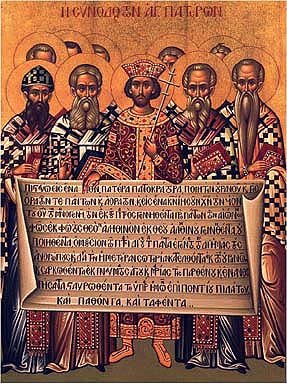
The following is an excerpt from “my” catechism on faith and its object. It is a mixture of thomisitic, reformed, and eastern orthodox elements. It is obviously a work in progress.
What is faith?
Faith is certain knowledge whereby I hold as true all that God has revealed in his Word, as found in Holy Scripture and the Tradition of the Church.*
What is the object of faith?
The object of faith is God: the Father, the Son and the Holy Spirit.**
What are the articles of faith?
The articles of faith are certain truths, first, concerning the origin of our God and Savior Jesus Christ in the eternal Father, his coming to earth, his life, death and resurrection; and, second, concerning the gift of the Holy Spirit, the Holy Church, and the promise of eternal life.
From where do we learn the articles of faith?
The articles of the catholic-orthodox Faith are according to the creed of First Nicea and Second Constantinople. Like the words of Holy Scripture, some of these articles are clear in themselves while others contain certain mysteries, from which other things are known.***
* Heidelberg Catechism, answer to question 21, modified.
** Summa Theologiae I-II, q. 1, a. 1
*** Catechism of Peter Mohila, Metropolitan of Kiev, I, q. 5, modified;
Summa Theologiae I, q. 1, a. 10
Friday, June 09, 2006
Are Western Christians Iconodules? Part I
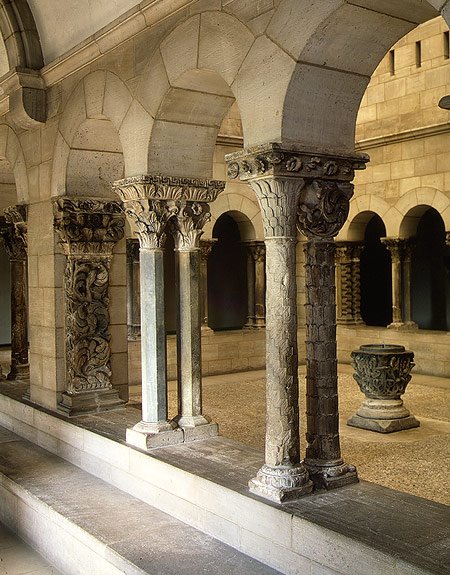
Since I am on the topic of iconography, let me propose an hypothesis regarding one aspect of the iconographical differences between the Roman Catholic Church and the Eastern Orthodox Church.
The Latin Bishops of the 8th century did not finally reject the canons of the Second Council of Nicea. The Roman church at the time of the Reformation reiterated its condemnation of iconoclasm. And yet, the use of images in public and private worship never became in the West what it became in the East. Its seems then that the tem 'iconodule' is more approprately given to Orthodox Eastern spirituality than to Roman Catholic spirituality. Perhaps the latter communion can best be described as not, on the one hand, icononclastic and yet, on the other hand, not iconodulic.
It is difficult to imagine the Orthodox liturgy without icons, whereas the Roman rite was never dependent upon sacred images. In fact, the medieval Cistercian sanctuary was as imageless as a Calvinist chapel.
A Dialectical Defense of Iconography
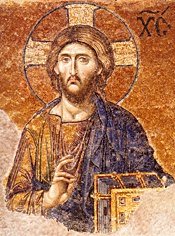
Since nothing especially important is on my mind at the moment, and since I will have wasted my time creating this blog if I do not begin to post some ideas, the following is a recent reflection on the possibility of a dialectical refutation of the charge of idolatry sometimes made again the Byzantine icon of Christ.
It seems that the genus ‘idol’ (taken in the literal sense of an artistic expression of deity which necessarily falsifies what it represents rather than in the analogously moral sense of any object of inordinate desire) can be divided into two species: (1) a true image of a false god or (2) a false image of the true God. The categories ‘false of image of a false god’ and ‘true image of the true God’ are inadequate for the reasons that the former is unintelligible and the latter would - by definition - not be an idol.
The sacred image of the God Jesus Christ fits neither of these two definitions. With respect to the first, it cannot be held that the sacred image of Christ is an image of a false god. This would be a denial of his divinity. With respect to the second, it cannot be held that the sacred image of Christ is a false image of the true God. This would be a denial of his humanity. Christ, according to orthodox belief, is fully human. Consequently, his human nature is as imitable as our own. Art can express the true form of God the Son in his humanity without falsifying it. The only definition that can be given to the icon of Christ is that of a true image of the true God.
Is seems therefore, on the basis of this observation, that there is neither a specific nor a general common definition of idol and icon.
Subscribe to:
Posts (Atom)

